
Industrial digitalisation with AI: 10 practical ways to get started
Industrial digitalisation with AI does not have to start with replacing a large information system or launching a major development project. Often, it is more sensible to start with a workflow where too much time is spent on manual work, information is spread across different systems, or the overview needed for management is created too slowly.
AI creates the fastest value for industrial companies in areas where there is a lot of repetitive information processing and decisions are made based on existing data. For example, AI can support production planning, process monitoring, technical document management, sales work and customer feedback analysis.
For a business leader, AI adoption needs to create visible business value. For an IT leader, the change needs to be controlled: data, access rights, integrations and security risks must be thought through.
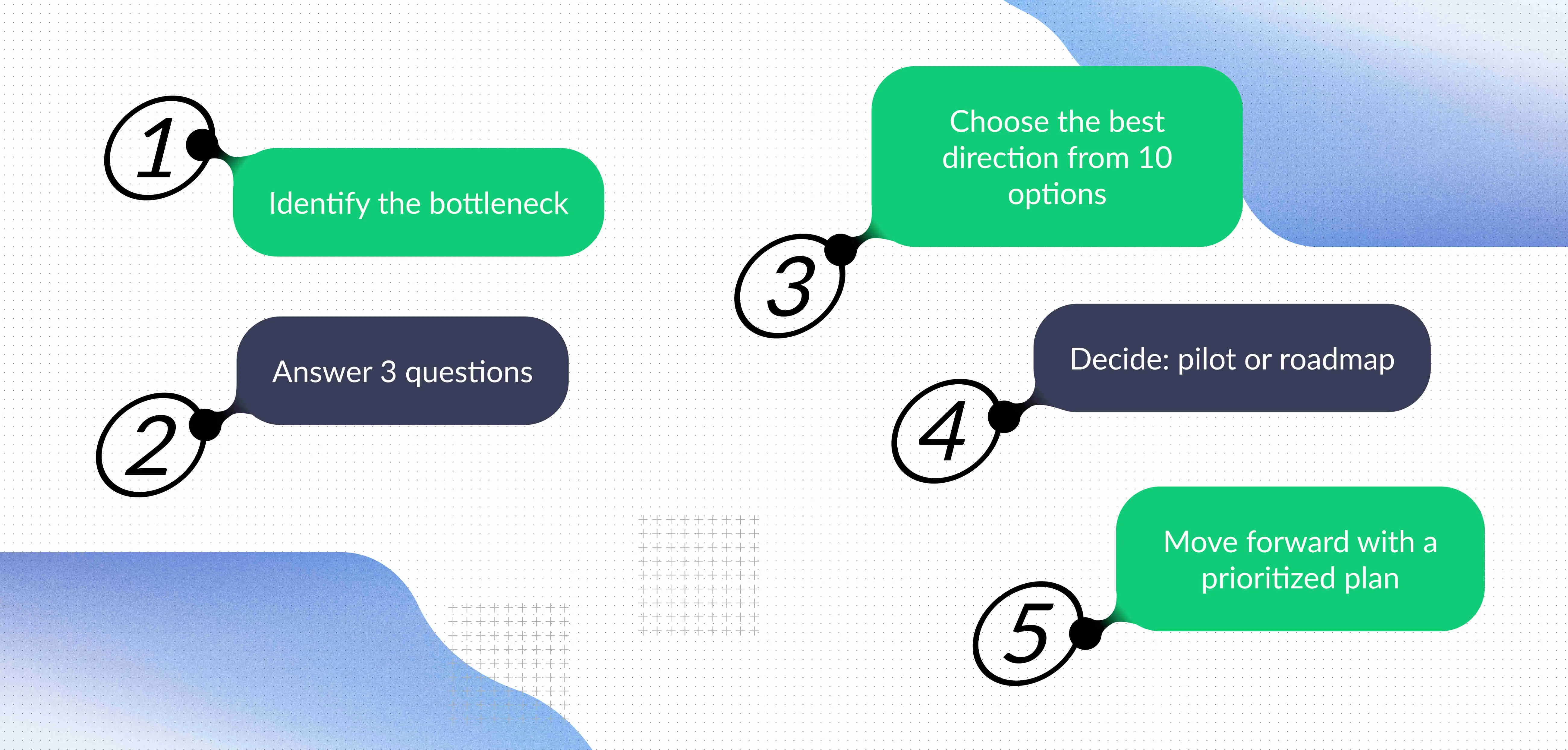
Before adopting AI or new software, it is worth answering three questions:
- Which process needs the most support?
- Which result do we want to improve?
- Which data and systems are needed for this change?
Once these answers are clear, it is easier to decide whether to start with a simple AI workflow, better use of existing software, an integration, data analytics or a custom solution.
If there are several ideas and the investment decision needs to be justified, an AI and technology roadmap helps map work processes, assess AI and technology opportunities and prioritise the next steps. If the company already has a digitalisation roadmap, it can apply for EIS funding to implement the consulting and development activities described in it. The Ministry of Economic Affairs and Communications is also preparing an AI adoption support measure, which helps companies test AI solutions and adopt them in their work processes. The grant conditions, eligibility and application status should be checked on official EIS or government channels before making a decision.
Let’s look at 10 practical opportunities that help you assess where AI can create the fastest value in your manufacturing company.
1. Industry overviews and market analysis
Every industrial company is affected by raw material prices, supply chains, competitor activity, new regulations and customer expectations. There is a lot of information to follow, and when this is done manually, important signals can easily be missed.
AI can prepare regular industry overviews, highlight important changes and create initial summaries for management or the sales team. For example, an AI agent can monitor industry news, procurement portals, trade fair catalogues, competitors’ websites and public data sources.
The greatest value is created when AI does not simply summarise news, but answers the company’s specific questions, for example:
- Which market changes affect purchasing or sales decisions?
- Which competitors are more active?
- In which countries are new opportunities emerging?
- Which trends need management’s attention?
2. Mapping new partners and sales opportunities
Cooperation between industrial companies is often based on long-term relationships. New contacts, however, often start from trade fairs, procurement requests, export programmes and industry events. Reviewing this information takes a lot of time.
AI helps find suitable contacts faster. For example, it can analyse trade fair catalogues, company lists or procurement portals and highlight companies that match set criteria.
It is important that AI does not replace sales or partnership relationships. It makes the preparation faster. A person still assesses suitability, creates the contact and decides whether the cooperation makes business sense.
3. Production planning and work management
Production management requires a constant balance between orders, people, equipment, materials, maintenance and deadlines. When information is fragmented, planning becomes slow and depends too much on the experience of individual people.
AI can support planning by analysing existing data and highlighting areas where there may be a risk or resource conflict. For example, AI can help assess how a delay in one material affects the production plan, or which orders need the same machine, production line or people’s time at the same time.
In the first stage, AI does not need to make automatic decisions. It is often better to start with a solution that helps the planner see more quickly where the problem is and what options are available.
4. Process monitoring and finding bottlenecks
Many production processes work in the same way for years. This creates stability, but it can also hide inefficiencies. Small deviations, stoppages or quality problems are not always immediately visible.
AI can analyse production data, work history, reports, photos, quality indicators and maintenance information. Based on this, it can identify patterns that would take too much time to find manually.
For example, AI can help notice:
- recurring stoppages;
- deviations in material use;
- recurring causes of quality problems;
- workflow bottlenecks;
- equipment operating patterns;
- differences between lines or shifts.
This supports data-based management, so decisions are not made only based on intuition or individual cases.
5. Data analytics and management information
Industrial companies have a lot of data, but it does not always become a clear management view. Data is located in different systems, spreadsheets and documents. Management, however, needs an answer to a simple question: what is happening right now and what should we do next?
AI can help summarise, explain and interpret data. For example, a manager can ask which processes have been delayed the most during the last month, which production lines have an increased quality risk, or which customer feedback points to recurring problems.
AI does not replace proper data architecture or agreement on metrics. However, it helps turn data into more usable management information when the underlying data is sufficiently well organised.
6. Supporting product development
Product development needs different perspectives: customer needs, technical limits, production capacity, price, materials, maintainability and market expectations. For example, AI can help create alternative product concepts, analyse warranty cases or summarise customer feedback.
AI can also give critical feedback through different roles, for example by assessing a solution from the viewpoint of a quality manager, maintenance partner or end user.
This does not mean that AI does product development instead of people. The value comes from helping the team test more options faster and notice risks earlier.
7. Competitive analysis and technical comparison
Sales and product specialists often need to answer questions about how one product differs from a competitor’s solution, what the technical advantages are and how to explain them to the customer.
AI can create initial comparison tables, analyse technical documents and highlight sales arguments. If the input includes competitors, product descriptions, certificates and comparison criteria, AI can quickly do a large part of the preparatory work.
The result must always be checked by a specialist, because AI helps with speed, while a person is responsible for accuracy and conclusions.
8. Automating sales processes
Strategic sales is people’s work, but there are many repetitive tasks around it. Drafting offers, summarising meetings, updating the CRM, comparing contracts and preparing follow-up emails all take time that could be used for more meaningful customer work.
AI can help prepare initial offer texts, summarise customer meetings, prepare sales arguments and find similar examples from previous cases.
The greatest value is created when AI is connected to the company’s real tools, such as the CRM, document management system, marketing software and knowledge bases. This means AI is not just a text generator, but part of the sales workflow.
9. Technical document management
In an industrial company, documentation is business-critical. User manuals, maintenance guides, certificates, quality documents, technical descriptions and contracts must be up to date and easy to find.
It is often assumed that AI cannot be used in this type of work because the data is sensitive. In reality, AI solutions can also be built in closed and controlled environments. The important part is choosing the right architecture, access rights and rules for using data.
AI can help organise, search, compare, translate, summarise and check documents. For example, an employee can ask which maintenance guide applies to a specific model or whether a document includes the requirements needed for an export market.
10. After-sales service, warranty issues and customer satisfaction
Warranty cases and after-sales service provide a lot of information about the product, process and customer relationship. Often, this information is used only to solve a single case, although product development, quality management and sales could also learn from it.
AI can help sort requests, find similar previous cases, suggest next steps and turn recurring problems into management information.
The same applies to customer satisfaction. Free-text responses contain a lot of valuable information, but analysing them manually takes time. AI helps find recurring themes, emotions, problems and strengths. This allows customer feedback to become input that helps the company make better decisions.
When is a digitalisation roadmap needed?
If the company has one clear problem, it can start with a small pilot. For example, it can test how AI helps find technical documents faster, summarise customer feedback or make offer preparation easier for the sales team.
If there are several AI and digitalisation ideas, many systems and investment decisions that need justification, it is sensible to create a digitalisation roadmap. It helps describe the company’s current situation, bottlenecks, priorities, required investment and expected impact.
The EIS Grant for preparing a digitalisation roadmap is currently closed. If the company already has an up-to-date digitalisation roadmap, it can apply for EIS funding to implement the consulting and development activities described in it. According to EIS, the funding can be used to address bottlenecks and implement development opportunities described in the roadmap, including consulting and development activities. The Ministry of Economic Affairs and Communications is also preparing an AI adoption support measure, which helps companies test AI solutions and adopt them in their work processes. The grant conditions, eligibility and application status should be checked on official EIS or government channels before making a decision.
AI opportunities can naturally be included in this roadmap. This makes it possible to assess which solutions make business sense, are technically feasible and are sufficiently secure for the company.
A structured audit is a good way to create this full picture. As part of Trinidad Wiseman’s AI and technology roadmap, a concrete action plan is created together with your team. This helps you make the next investment decisions with more confidence.
In this type of work, it is important that the partner does not look at AI as a separate tool, but connects it with processes, data, users and the existing technology environment. At Trinidad Wiseman, we combine the perspectives of analysis, service design, software development, data analytics and user experience.
Read more about the sample roadmap report on our AI and technology roadmap page. If you would like to discuss which AI or digitalisation opportunity could bring the greatest practical value to your company, please contact me. I am a Custom Software Development Consultant at Trinidad Wiseman, and the first consultation is without obligation and does not require further cooperation.
How to start industrial digitalisation with AI?
Frequently asked questions about industrial digitalisation and AI adoption
About the author
I am a Custom Software Development Consultant at Trinidad Wiseman. I help companies find practical ways to digitalise work processes and adopt technology. I advise clients when they have several ideas, but need a clearer view of where to start, which solution would create value and how to prioritise the next steps.
I am happy to help if you would like to discuss which AI or digitalisation opportunity could bring the greatest practical value to your company. The first consultation is without obligation and does not require further cooperation.