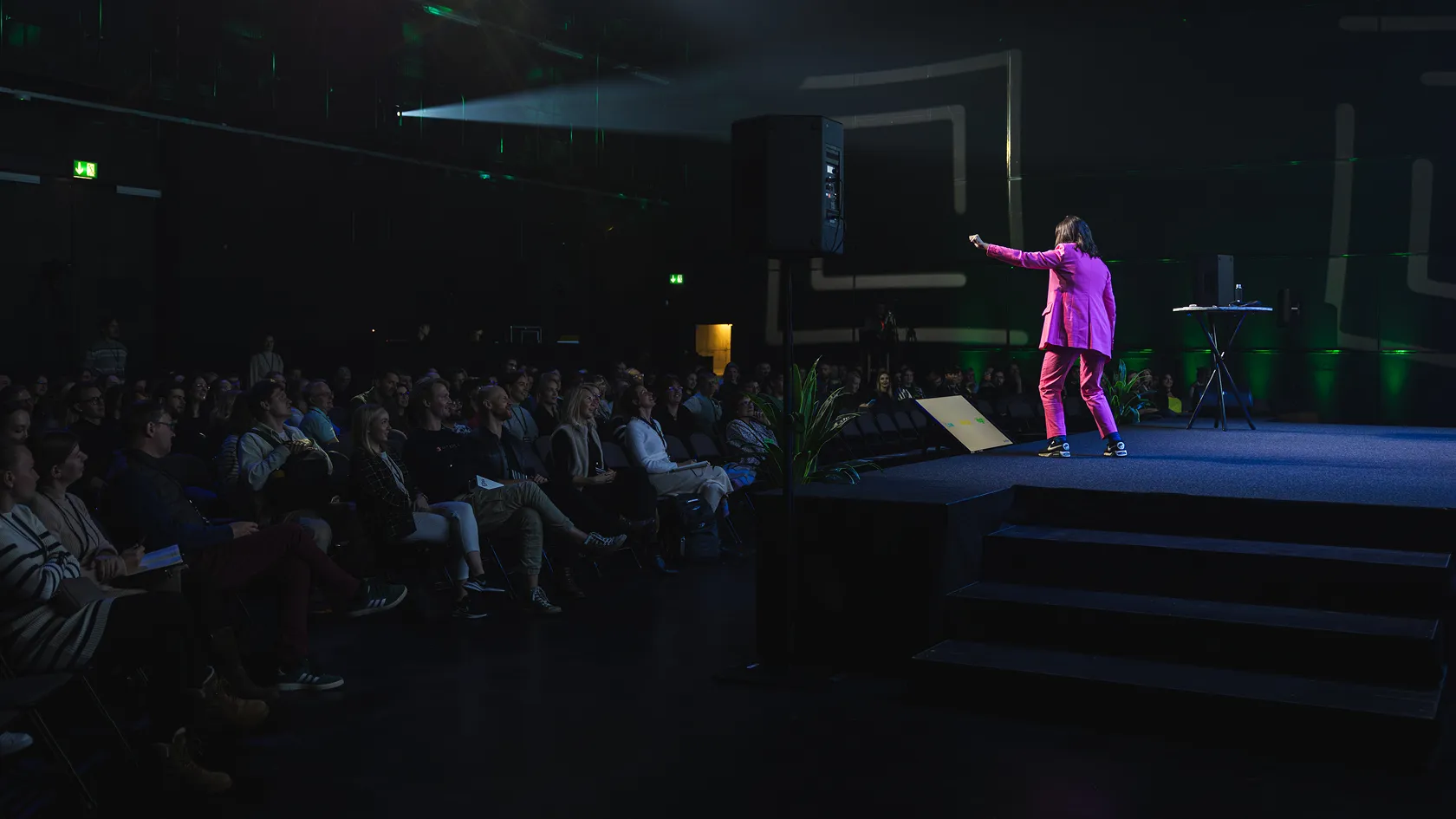
There are events where people go to listen to presentations. There are also events where people go to gain new perspectives and ideas that can actually be put into practice. For many, the WUD Estonia conference belongs clearly to the latter.
Over the years, WUD has brought together designers, developers, product managers, and executives who share one key question: how to make better decisions when creating digital services and products. In recent years, the focus has increasingly shifted from design as execution to design as a strategic tool.
In this story, people who have attended WUD many times share their experiences. They talk about why they keep coming back, which ideas and perspectives have stayed with them, and which topics they are most looking forward to in this year’s programme.
For many, WUD is not just a conference, but a place people come to because of the people and the way of thinking. What matters is not only the programme, but also an environment where specialists from different backgrounds come together for a day and talk openly about real-life decisions.
“I have been attending WUD since 2021, and I go there first and foremost because of the people. Organisers, speakers, sponsors, and the audience come together, and this combination has its own special energy. I have been a volunteer in the conference organising team for several years, and this has helped me better understand how much commitment and care this community carries.” — Anna Shishkova, product business analyst, Evolution
Repeat visitors also point out that WUD offers perspectives that are not always encountered in everyday work, even when the topics may seem familiar at first glance.
“I have attended WUD from the very beginning, both on my own and with a team, with only a few years missed. I always meet some of the best professionals in my field from Estonia and beyond, and every year there is at least one presentation that shows a familiar topic from a completely new angle.” — Kaspar Roost, head of design operations, Swedbank Group
For many respondents, it is also important that the conference is strong in content while still remaining accessible. For some visitors, the value of WUD lies not in ready-made answers, but in the ability to better understand problems and the choices being made.
“I have visited WUD for three years because it is the largest design conference in Estonia, with high-quality content and a reasonable ticket price. Every time I attend, I take something new with me and my perspective broadens. It has also been interesting to see how others approach similar problems and how supportive the design community really is.” — Kristyna Mertova, product designer, Bolt Technology
“When I come to WUD, I am not primarily looking for ready-made answers. For me, it is more important to learn how to ask better questions and to understand why certain design decisions work in real life. This also has direct value in business decision-making.” — Epp-Kristiina Keerov, head of digital, Helmes
The impact of WUD is not limited to the conference day itself. For many participants, it has been a clear turning point that has changed how they notice and interpret design and user experience in their daily work.
“Vitaly Friedman’s workshop was a clear “before and after” moment for me. Once you have seen how good UX actually works, you can no longer ignore a passive button, an awkward user journey, or an extremely complex form.” — Anna Shishkova, product business analyst, Evolution
For others as well, WUD is a place where they can review their current ways of working and keep them fresh.
“Workshops, in particular, are a good opportunity to revisit user-centred design methods and to learn new or improved approaches.” — Kaspar Roost, head of design operations, Swedbank Group
“I have been attending WUD for eight years, and it gives me new perspectives and helps me approach the same things in a completely different way. This keeps my thinking fresh and helps prevent all projects from blending into one uniform mass.” — Epp-Kristiina Keerov, head of digital, Helmes
In addition to long-term experience, WUD also helps people distinguish which views and practices actually work.
“At WUD, you can hear very different perspectives on design and product development. It is like a menu from which you can choose what resonates with you or challenges your previous assumptions. One idea I have genuinely taken into my work is the PM–designer cooperation model.” — Kristyna Mertova, product designer, Bolt Technology
The ideas taken from WUD may not always be applied immediately, but they remain and come to the surface at the right moment.
“There are always many ideas and a lot of information. They stay in my subconscious and resurface exactly when I need them to solve my work-related tasks.” — Anna Shishkova, product business analyst, Evolution
Some ideas have been so clear and concrete that they have started to guide everyday decisions.
“Vitaly Friedman’s phrase ‘disabled buttons are very expensive’ often comes back to me. It has changed how I think about errors and user guidance.” — Kristyna Mertova, product designer, Bolt Technology
For many respondents, it is important that design is not treated merely as a visual matter, but as part of business decisions and responsibilities.
“Aesthetics is subjective. Value comes down to whether and how a solution fulfils its purpose. If the goal is to get people to complete a form without errors, a beautiful design does not make a high error rate acceptable. It is equally important for sales and marketing teams to understand the principles of design and usability. Too often, poor decisions are driven by personal preferences such as “I like it”, rather than by actual user behaviour and data. The web is not a place where users should learn new habits, but where a service must be immediately understandable.” — Epp-Kristiina Keerov, head of digital, Helmes
Others also point out that usability and profitability are closely linked, especially in competitive fields.
“When prices are similar, people start choosing based on how pleasant the product is to use. This shows a direct link between user experience and business outcomes. Even when artificial intelligence is used, the need for design decision-making does not disappear. On the contrary, it requires an even clearer understanding of responsibilities and roles.” — Kristyna Mertova, product designer, Bolt Technology
Clear goals and a clear division of responsibilities are seen as essential when making design decisions.
“Breathing down a designer’s neck does not lead to a good result. It is important to clearly define from the beginning why decisions are being made.” — Epp-Kristiina Keerov, head of digital, Helmes
The main theme of this year’s WUD is particularly relevant for many respondents.
“The topic “Where design shapes strategy” is very important in my role, because I am involved in the entire product development cycle. I am also interested in accessibility, inspiring experience stories, and developments in artificial intelligence. For me, design is not just about form or a beautiful user interface, but a way of thinking and making decisions.” — Anna Shishkova, product business analyst, Evolution
“I am especially looking forward to Harri Kiljander’s presentation on design as a strategic lever and how leaders connect UX to business impact, because it connects closely to my PhD research interest. I am also interested in the panel discussion with the provocative title “Is a designer a cost or a competitive advantage?”, which explores the role of design from the perspective of decision-makers.” — Kaspar Roost, head of design operations, Swedbank Group
“Vitaly Friedman’s presentations are always exciting. I am interested in design operations and how different teams approach them in practice, because their presence or absence directly affects designers’ work and testing opportunities. I would also like to see more career-focused topics at WUD in the future, such as how to develop from mid- and senior-level roles.” — Kristyna Mertova, product designer, Bolt Technology
Participants also hope to see more practical perspectives on analytics, accessibility, and design measurement.
“I would like to see more discussion on how to measure why an action or purchase decision is not made, and what role specific design choices and data play in this.” — Epp-Kristiina Keerov, head of digital, Helmes
The same theme is explored in more depth in Helmes’ perspective on this year’s WUD. In the article “UX is not just a design thing”, Epp-Kristiina Keerov explains why user experience is not a cosmetic detail, but a deliberate strategic choice that shapes decisions and outcomes across the entire organisation.