How to test product packaging designs with brainwaves?
Have you ever thought about why you feel all kinds of different emotions when walking along store aisles and looking at different packages? Have you noticed that holding one package makes you feel warm and fuzzy while another feels boring or even distasteful?
In this article, we will be talking about human reactions, measuring and interpreting human brainwaves, and about how the information gathered from the previous can be used to help product development and marketing teams make more consumer-friendly decisions.
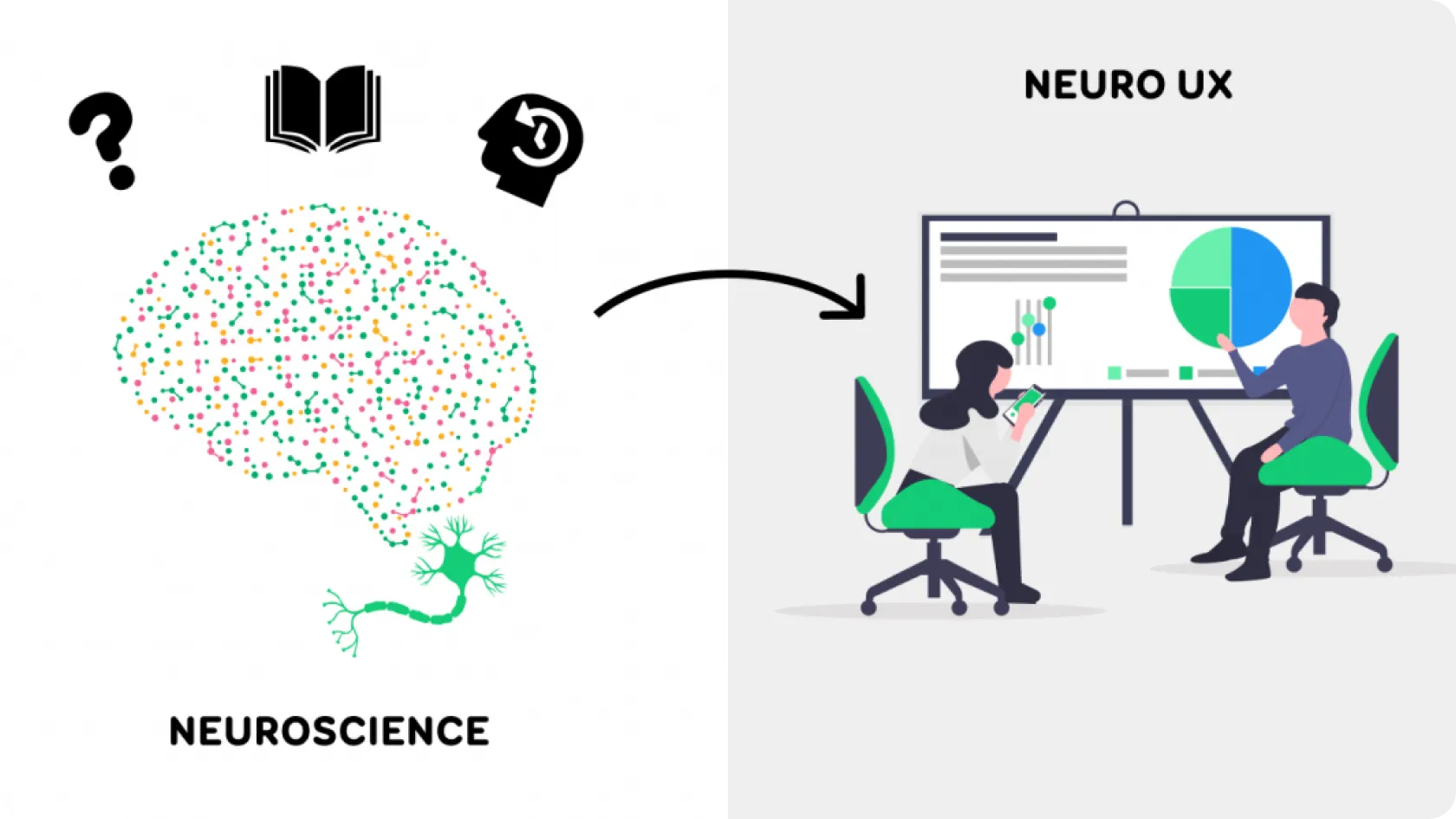
- neuroscience focuses on the brain, the nervous system, and how both affect behaviour and performing various tasks, such as thinking, learning, recalling.
- neuro UX uses neuroscience to study a user’s reaction and ability to perform various tasks and stimuli.
Let us look at an example: usually, when we look at a product package, we immediately understand whether we like it or not. If we need to explain that, then we may discover that it is hard for us to describe the emotion we felt when looking at the package.
We may not understand exactly which element of the packaging we are drawn towards or repelled by. This is where we can measure brainwaves and implement eye tracking.
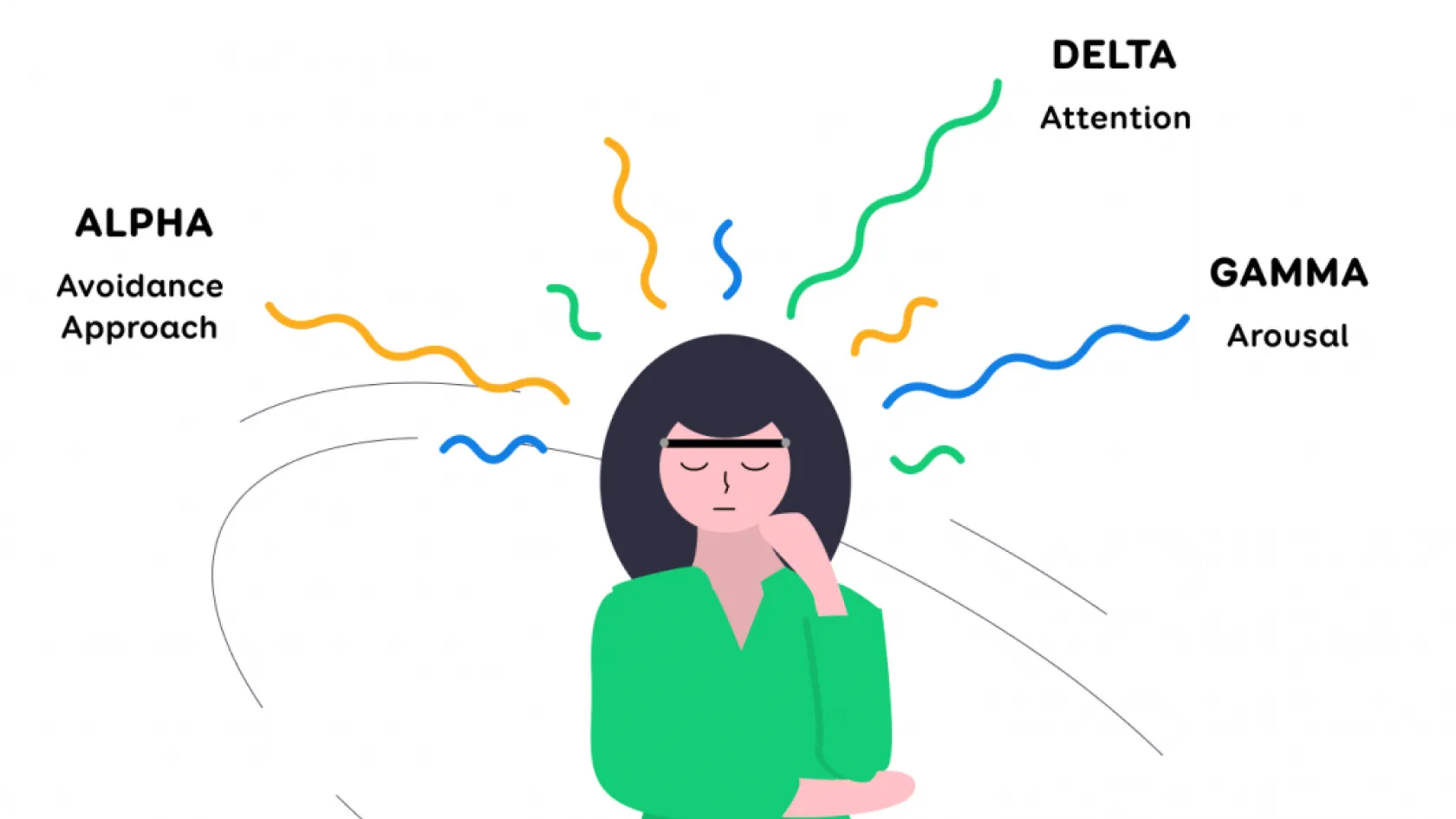
Brainwaves are measured from different parts of the brain, dependent on what kind of task the user has been given. At Trinidad Wiseman, we use the MUSE – EEG sensor and we measure brainwaves from the user’s frontal lobe, which is the centre for resolving voluntary motoric tasks and the basic emotional properties of people. We also measure brainwaves from the temporal lobe, which is the centre for behaviour, memory, hearing, and understanding languages.
But measuring brainwaves alone is not enough to understand connections and create a complete picture of the user’s reactions.
Measuring brainwaves informs of events like the user hearing something or being irritated or happy about something. But we are more specifically interested in why any of those things happened.
That is why, in addition to brainwave measuring, we also use screen and audio recording and record all of the actions performed by the user on-screen. For example, for packaging designs, we use slideshows with pictures of the packages that we want to gather human reactions for.
Additionally, we also show the package to the user within the context of an online store along with a price, competitors’ packages and other factors that affect human reactions.
We use eye tracking during the test to obtain information about what exactly the user is looking at at any given time and we can then compare that data to the brainwave measurements at the exact same time. This helps us understand which design element caused which emotion. Finally, we also use facial emotion recognition.
Since people’s emotions can change a lot within the span of one second due to various stressors (e.g., when testing packaging designs, we add a competitor’s package next to the design being tested), then we are able to gather huge amounts of data as a result of all the previously mentioned measurements.
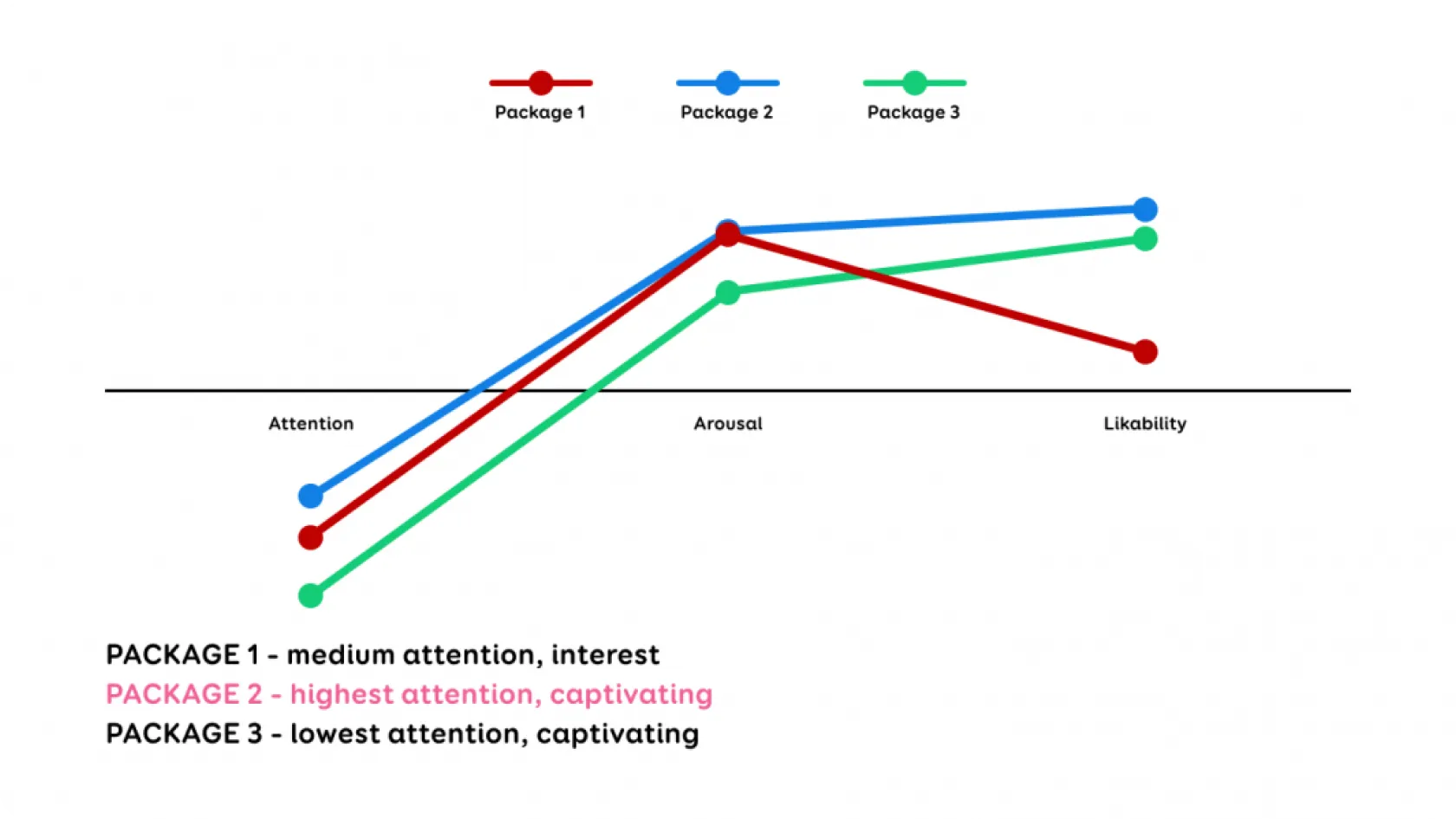
We start processing data by calculating averages based on our goals and then we get to work on thoroughly analysing those. We compare all of the averages to a 30-second baseline AKA measurement results that we record right before the start of the test. As a result of the analysis, we get a complete overview of the user’s reactions when performing specific tasks.
- arousal – gamma waves
- attention – delta waves
- avoidance – alpha waves
- approach – alpha waves
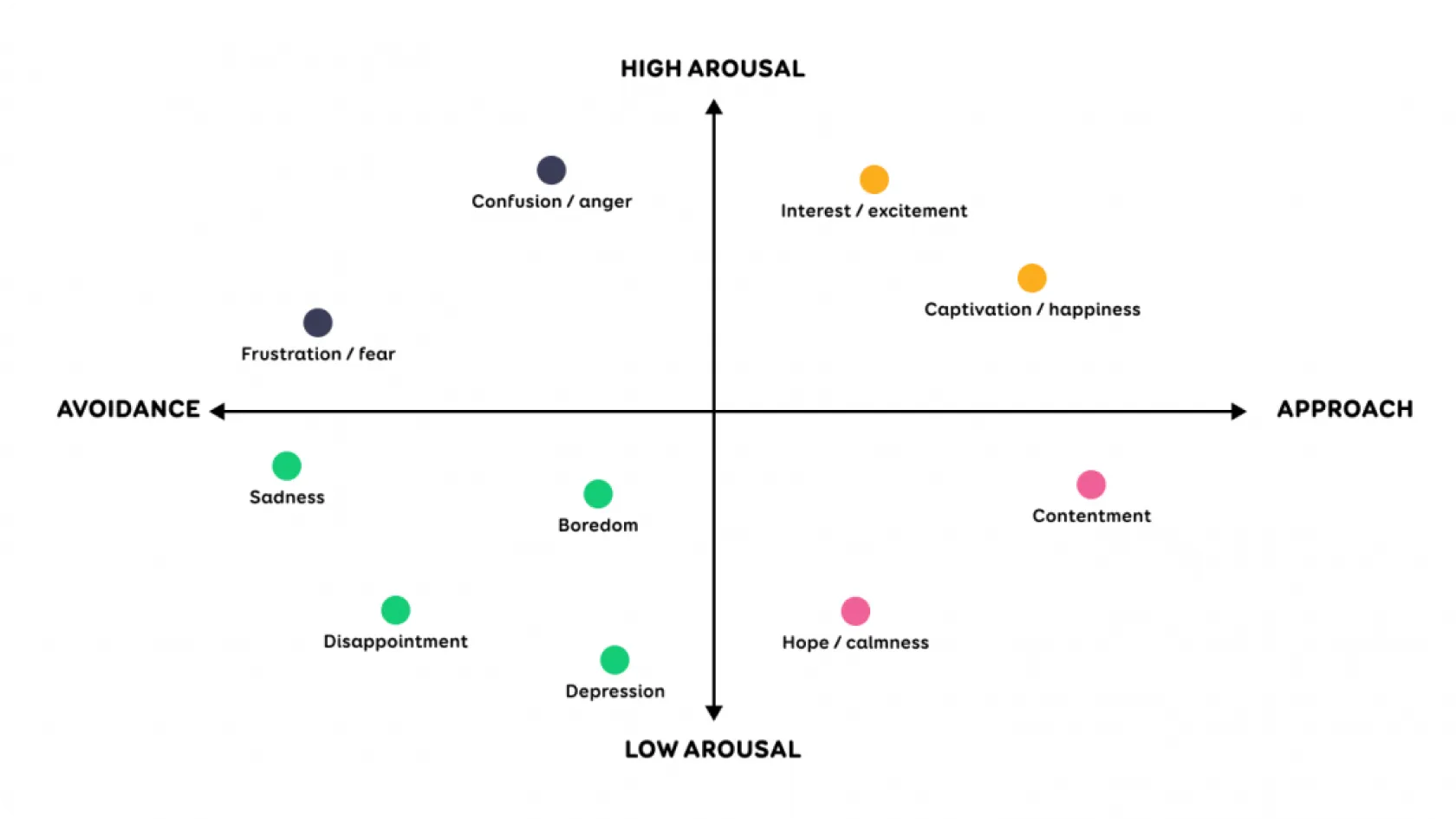
A graph for interpreting brainwaves and drawing conclusion about them
For example, when testing product packaging design, a user interface or a commercial clip, then we are aiming for a result in the upper right quadrant, which shows “a high level of arousal + approach”. There, the user’s interest AKA arousal towards the product is high and is thus very likely to motivate the user to do something for it (e.g., purchase the product or click the button).
The qualitative goal
For design decisions, we are interested in the reaction of a single person to move on to the next step. Often, we need initial decisions on whether or not an element should be kept in the design.
In other words, we need to evaluate whether the user notices that detail, whether they must make an effort to understand it, and whether it creates a positive or negative emotion in them.
For the qualitative goal, 5 is the optimal number of people to test. Their measurement results can be used to make initial design decisions. Based on these initial decisions, an alternative packaging design will be created. Later on, a quantitative study can be conducted to select the best package from among the various different versions.
The quantitative goal
For final decisions – for example, the final launch of the package –, we need to know how much of the population likes the specific package and how much of it does not.
To fulfil the quantitative goal, we need to have a much bigger selection of participants for the test – getting the opinions of a minimum of 15 people and a maximum of 50 people is enough to calculate averages and analyse them. Statistically speaking, the selection should be composed in such a way that it includes all types of representatives of the population.
We at Trinidad Wiseman recommend testing packages with human reactions already during the design phase to determine whether the current direction is the right way to go. By doing this, you can save a lot of hours that would otherwise be wasted on unnecessary work.
The package does not need to be completely ready to evaluate people’s first reactions – in our experience, a black and white prototype can already create a similar reaction in people as the final colourful package. The reaction might not be as strong yet, but it will already be revealed during the test.
We recommend testing with brainwaves in the following cases:
- if the goal is to get feedback about how users automatically react to an (incomplete) design
- if a production company wishes to determine which packaging design works the best from among multiple designs
- if the goal is to compare competing product packages (including comparing different design versions against them
”For example, the purpose of the study could be to select the most attractive package from the consumer’s point of view or to determine whether the packaging design needs to be changed/improved upon and how much.”
By doing this, we can figure out the “winning package” and we may even get a couple of comments. However, unfortunately, we will not be able to get the consumer’s objective opinion since we are too closely attached to the product being tested and we are also affected and swayed by our job and company.
Because of that same reason, we are also unable to learn what the person’s actual first impression and feelings were when they looked at the package.
”By using surveys, we can only gather answers and comments that the user themself has already analysed, not their actual genuine reactions.”
This is because people…
- cannot put their emotions into words – they feel a lot of feelings at the same time and are incapable for selecting the dominant one
- start to automatically analyse why something is being asked or what is meant by it
- think about what kind of answer is most desirable for the asker
- think about what kind of answer is presumed/expected from them
- are worried about what will happen to them if they provide one answer or another and change their answers accordingly
”We measure the reactions of the human body and brain to find that precise moment where the person has not yet started to knowingly analyse anything.”
From a business point of view, the main reason for using this research method is to make decisions about packaging design on the right bases. Product packaging can significantly affect purchasing decisions because we “eat with our eyes” – that is why it is important to determine the consumer’s true reaction to even the smallest of changes.
”Any activities that allow us to leave behind the usual situation of 50% chance of success and 50% chance of failing are a huge win for marketing.”
It is a lot more cost-effective to play around with the packaging design during the design phase and to keep changing it step by step until the results are satisfactory than to lose sales or to make changes to a package that has already been launched.